
The Story Behind the Print
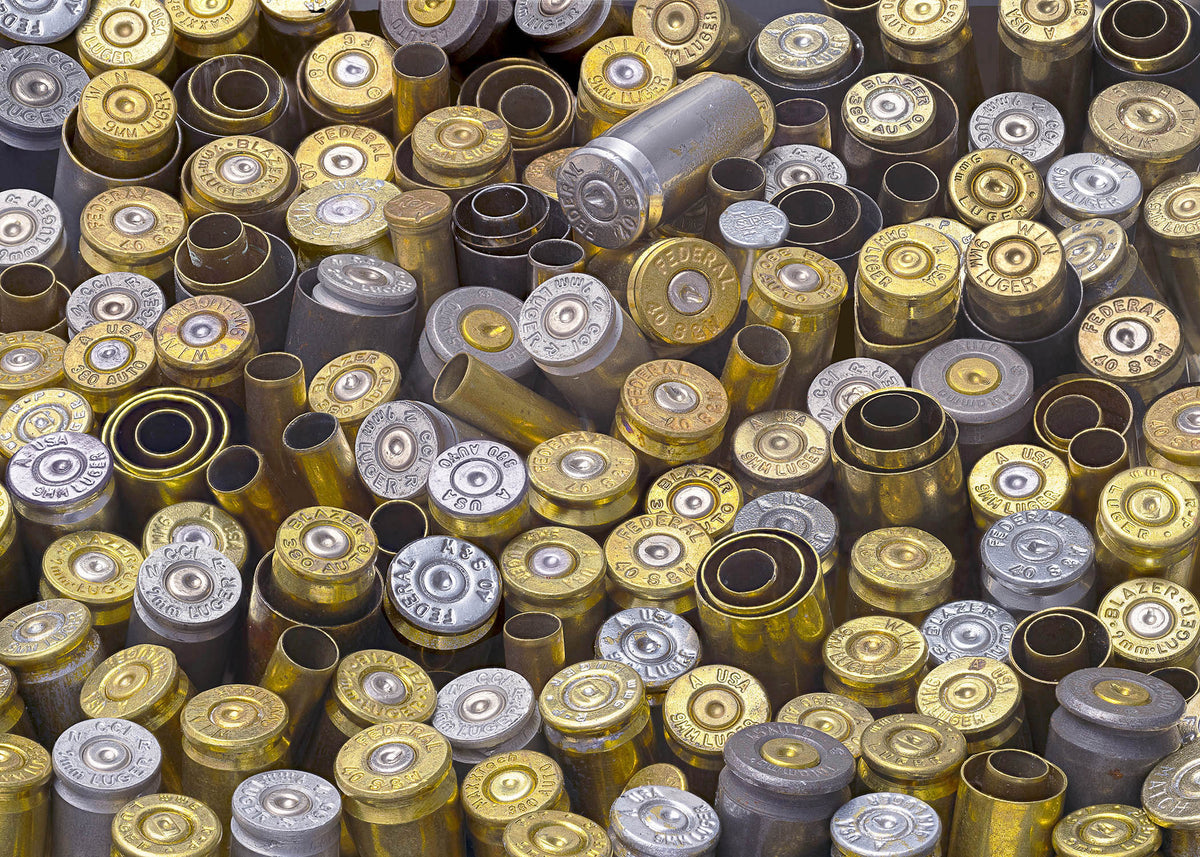
I found these spent brass bullet casings completely by chance, tucked away in an old mill that sold all types of vintage odds and ends. They were packed tightly inside a Mason jar. The moment I saw them, I could already imagine the composition hiding beyond the glass.
Up close, the casings create this dense, almost topographical surface. Their different sizes, finishes, and ages, from bright silver tones to warm brass and deep tarnish build a shifting texture that pulls your eye across the frame. Each base has its own stamped markings and bits of text, small reminders of where these objects came from and what they were originally made to do. Arranged together, they stop feeling like discarded remnants and start forming a pattern that hints at conflict, consequence, and transformation.
A Study of Aftermath
What interests me most is how these casings outlive their purpose. Once tools of force, they now exist only as form, stripped of function but still carrying history. Their repeated shapes and physical weight invite you to think about what remains after an action ends.
Even the maker’s marks feel like accidental signatures, tiny records of origin that persist long after their moment of use. In the end, this piece is really a study of aftermath—finding meaning not in the event itself, but in what’s left behind. It’s a reminder to look closely at the things we usually overlook, because even the smallest fragments can hold stories of impact, memory, and change.
Technical Specifications
The image was created using a high-resolution digital back paired with a modern view camera, combining traditional photographic craftsmanship with contemporary precision. This approach highlights the tactile details and subtle textures of the worn and abused surfaces, capturing both the physical presence and emotional qualities ingrained through its altered appearance.