
The Story Behind the Print
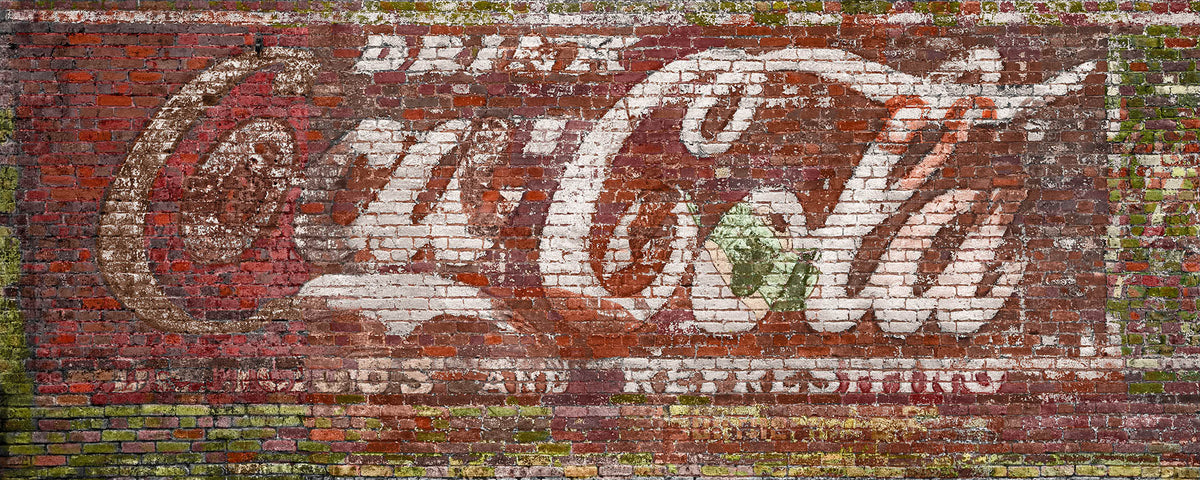
I discovered this striking ghost sign while exploring the historic streets of Fayetteville, Tennessee, and captured it using my ultra-large-format 8x20 wooden panoramic view camera. I was immediately drawn to the raw, visceral texture of this brick wall, which features a heavily weathered, hand-painted vintage Coca-Cola mural. Over decades of exposure to the elements, the iconic script logo and the classic "Delicious and Refreshing" slogan have beautifully fractured, letting the deep crimson of the underlying masonry break through the fading white paint. It stands as a powerful visual monument to mid-century American advertising, capturing a moment where a mass-produced corporate symbol has slowly dissolved into a piece of local organic history.
What elevates this photograph into a truly profound historical record is a subtle, magnificent detail hidden in plain sight. This is a double mural—a physical canvas where two distinct eras of commercial art actively coexist. If you look closely directly behind the sweeping white letters of the "Co" in Cola, the faint, ghostly remnants of an earlier, underlying advertisement reveal themselves: the unmistakable green outline of a vintage contour bottle and a painted hand's thumb showing through the distressed layers of masonry. This quiet intersection of old campaigns turns the brick wall into a living archive, charting the evolution of American iconography as subsequent generations of traveling sign painters laid their work directly over the past.
The Panoramic Process
By choosing a dead-on, flat perspective that completely fills the wide frame from edge to edge, the composition transforms an ordinary street building into a sweeping landscape of texture and form. The sheer scale of the 8x20 negative preserves a breathtaking level of tactile detail—allowing the viewer to trace the physical grain of every individual brick, the chipped paint fragments, and the soft textures of the moss growth encroaching along the lower mortar lines. I originally exposed the scene on a single, massive sheet of traditional black and white film to secure the absolute sharpest micro-contrast. Later, I hand-colored the file in Photoshop from a high-resolution drum scan, applying a rich, warm palette of aged reds, faded whites, and organic greens. This interpretive colorization process removes the clinical reality of standard photography, wrapping the historic wall in a stylized patina that directly honors the craftsmanship of the original sign painters.